Other Ancient Birds
Ancient Birds: Strange Fliers of the Dinosaur Age
Birds have been on Earth for an astonishingly long time. Their ancestry reaches back roughly 150 to 200 million years to the age of dinosaurs, when the skies were filled not with robins, hawks, and geese, but with strange feathered creatures that looked partly reptilian and partly avian. Many ancient birds had teeth instead of beaks, clawed fingers on their wings, and long bony tails. They were evolutionary experiments, some successful for millions of years and others that vanished forever.
One of the earliest and most famous ancient birds was Archaeopteryx, which lived about 150 million years ago during the Jurassic Period. Roughly the size of a crow, it possessed unmistakable flight feathers much like those of modern birds. Yet it also retained many reptilian features, including teeth, claws on its wings, and a long tail made of individual vertebrae rather than the short fused tail of modern birds. Scientists debate whether it was a powerful flier or merely capable of gliding and short bursts of flight. Regardless, it clearly occupied an important place near the transition between dinosaurs and birds.
Soon after Archaeopteryx, birds diversified into surprising forms. One of the most successful groups was the enantiornithines, sometimes called “opposite birds.” These birds flourished during the Cretaceous Period and lived worldwide for nearly 80 million years. Although many resembled modern perching birds in size and shape, they differed anatomically in their shoulder structure and retained primitive traits such as teeth and clawed wings. Some species were tiny forest dwellers no larger than sparrows, while others occupied shorelines or open habitats.
Among the most unusual of the enantiornithines was Avisaurus, a turkey-sized predator that may have hunted small vertebrates and insects. Fossilized feet suggest it was adept at grasping branches, making it one of the earliest birds capable of perching effectively.
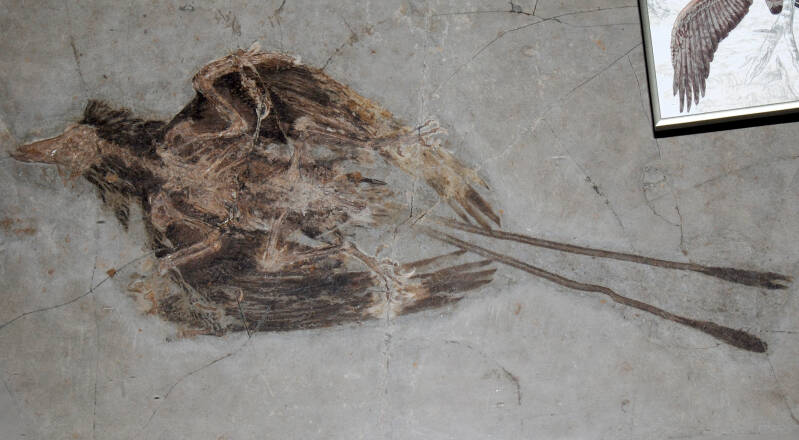
Another remarkable ancient bird was Confuciusornis (pictured above), which lived about 125 million years ago in what is now China. This species is important because it represents one of the earliest birds with a true toothless beak. About pigeon-sized, Confuciusornis likely fed on seeds or fruit. Some fossils preserve spectacular tail feathers, suggesting males may have used elongated plumes in courtship displays much like modern birds-of-paradise or peacocks.

Not all ancient birds lived in forests. Some conquered lakes and oceans. Hesperornis, which lived roughly 80 million years ago, was a large, flightless diving bird of North America. Resembling a loon or grebe, it had powerful legs positioned far back on the body, making it an excellent swimmer but awkward on land. Unlike modern diving birds, however, Hesperornis still possessed sharp teeth that helped it grasp slippery fish underwater. Fossils show it may have reached five feet in length.
Another seabird of the same period was Ichthyornis. At first glance it might have resembled a modern gull or tern gliding over ancient seas. It was an accomplished flier with strong wings and a keeled breastbone for flight muscles. Yet hidden inside its jaws were rows of sharp teeth. Ichthyornis demonstrates that even birds which looked modern externally could retain primitive internal features.
Perhaps the strangest ancient bird was Pelagornis, a giant seabird that appeared much later, around 25 to 3 million years ago, after the extinction of dinosaurs. With a wingspan estimated at up to 20 feet, it rivaled small airplanes in size. Instead of teeth, it possessed tooth-like bony projections along its beak, useful for catching fish and squid. It likely soared over oceans much as modern albatrosses do, traveling enormous distances with minimal effort.
Some ancient birds became giants after the extinction of dinosaurs. Gastornis (once called Diatryma) was a huge, flightless bird standing over six feet tall. Living around 50 million years ago, it had a massive skull and powerful beak. Once thought to be a terrifying predator, evidence now suggests it may have been primarily herbivorous, feeding on tough vegetation.
Then there were the so-called “terror birds,” members of the family Phorusrhacidae, which dominated parts of South America millions of years ago. Species such as Phorusrhacos stood nearly 10 feet tall and possessed enormous hooked beaks. Fast runners rather than fliers, they hunted mammals in a role much like lions or wolves occupy today.
Ancient birds remind us that bird evolution was not a straight path leading neatly to today’s species. Instead, it was filled with experimentation—birds with teeth, birds with claws, giant birds that hunted mammals, and seabirds with wings broader than many small aircraft. Every sparrow, eagle, and hummingbird alive today carries echoes of this ancient past. In many ways, birds are living fossils, descendants of creatures that once shared the world with dinosaurs and transformed the skies forever.