Avian Taxonomy
All birds are related. Over evolutionary time, different groups of birds arose while others went extinct. Perhaps as many as 135,000 species of birds have existed in their 250 million years of existance. Over the years early naturalists tried to tie the relationships of birds by their behavior, their color, their songs, and their anatomy. All of these methodologies had some merit, but today ornithologists have DNA as a tool and have refined their classification to a high degree of certainty.

Avian Taxonomy: How Birds Are Classified
Avian taxonomy is the scientific system used to classify and organize birds based on shared characteristics and evolutionary relationships. It helps ornithologists understand how different bird species are related, how they evolved, and how to identify them accurately. Modern bird classification combines traditional anatomy-based methods with advanced genetic research.
Major Divisions of Birds
All living birds are placed in Class Aves, but they are divided into two major groups based on evolutionary lineage:
1. Paleognathae
This group includes large, mostly flightless birds such as ostriches, emus, and kiwis. They have primitive skeletal features, particularly in the palate structure of the skull.
2. Neognathae
This is the much larger group, containing nearly all modern bird species. It includes everything from songbirds to raptors and waterfowl.
There are over 40 recognized bird orders, but a few dominate in diversity:
Passeriformes (Perching birds) – The largest order, comprising more than half of all bird species. Includes sparrows, warblers, finches, and crows. Others large orders are Accipitriformes – Hawks and eagles.Falconiformes – Falcons and caracaras. Anseriformes – Ducks, geese, and swans. Strigiformes – Owls. Piciformes – Woodpeckers and toucans.
Passeriformes alone accounts for over 6,000 species, making it the most diverse vertebrate order on Earth.
Birds belong to the class Aves, within the phylum Chordata. Taxonomy follows a structured hierarchy:
Kingdom, Phylum, Class, Order, Family, Genus, Species
For example, the American Robin:
Class: Aves
Order: Passeriformes
Family: Turdidae
Genus: Turdus
Species: Turdus migratorius
This binomial (two-name) system was developed by Carl Linnaeus in the 18th century and remains the foundation of modern naming conventions.
Modern Phylogenetics and DNA
Historically, birds were grouped based on visible traits such as beak shape, foot structure, and feeding behavior. However, DNA sequencing has revolutionized avian taxonomy. Genetic studies have revealed surprising relationships—for example, falcons are more closely related to parrots and songbirds than to hawks.
Organizations like the American Ornithological Society and the International Ornithologists’ Union regularly update official bird lists based on new genetic findings. As a result, species are sometimes split into multiple species or merged based on evolutionary evidence. See DNA in Avian Taxonomy
Why Avian Taxonomy Matters
Understanding bird classification is more than academic. It helps:
Clarify evolutionary history
Improve conservation planning
Standardize bird identification worldwide
Track biodiversity changes
For birdwatchers, taxonomy explains why certain species share similar behaviors or habitats. For scientists, it provides the framework for studying evolution, migration, and adaptation.
In essence, avian taxonomy is the roadmap of bird diversity—constantly refined as new discoveries reshape our understanding of the avian tree of life.
The American Robin, Order Passeriformes, is a passerine (songbird), along with about half of the birds in the world. Some of these birds, along with the robin, belong to the Turdidae, the thrush family - containing not only thrushes, but solitaires, chats, bluebirds, and the Redwing, Fieldfare. and Eurasian Blackbird. Further narrowing the classification, the robin has the genus name of Turdus, as do the true thrushes and various other species such as solitaires, cochoas, ant-thrushes, and bluebirds. Now we are down to migratorious, which tells us the specific bird, the American Robin, and no other. Turdus migratorious is the binomial scientific name, belonging to no other creature. This taxonomic scheme puts every species in its place relative to other species. The official definition of a species is that it is reproductively isolated from all other species. That's a pretty good definition. (Note that biologica species is always species, never specie - that's a coin.)
For many hundreds of years, the similar appearances of birds made naturalists think they were related. Sometimes they were but often they were not. The below share many similarities - size, bright colors, behavior, diet, etc. but the sunbird belongs to the songbird order, Passeriformes, while the hummingbirds are in the Caprimulgiformes, the nightjar order. They are no more closely related to each other than they are to ostriches!
Notice that family names (Turdidae, Sylviidae, Paridae, Gaviidae) are capitalized and end in -idae while order names (Passeriformes, Anseriformes, Podicipiformes, Apodiformes) are capitalized and end in -iformes. Scientific and common names are further explained in Names.
There are such things as subspecies, versions of species that differ in color, size, song or some other aspect but that can interbreed. Their scientific name is a trinomial. One example is the Tundra Swan which as two subspecies: theTundra Swan (Whistling), Cygnus columbianus columbianus and the Tundra Swan (Bewick’s), Cygnus columbianus bewickii.
Note that "species" is always "species", whether we are discussing one or more than one species. Never "specie", the word for a coin.
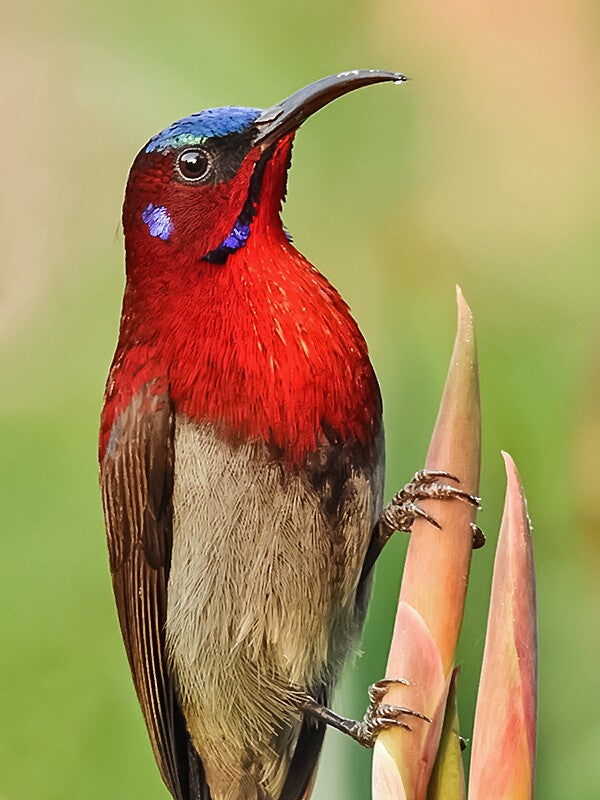
Vigor's Sunbird and Rufous Hummingbird
Click photos to enlarge.

Without getting into too much detail DNA is extracted from the blood of two bird species. The double-stranded DNA is split into single strands. The the two different DNA strands are mixed so that some of the individual strands of one species pairs up with another, forming a hybrid double-stranded DNA molecule. Then heat is applied to this double strand which will cause the strands to separate at some point as the heat rises. The more heat it takes to separate the strands, the more similar the strands are , reflecting the relationship between the birds. DIstantly related hybrid DNA separates at relatively low temperatures, indicating only distant relationships between the birds.
There is also DNA sequence analysis, but I won't get into that. You can read a comprehensive and fascinating history of ornithological classification and taxonomy and a detailed explanation of DNA analyses in a book chapter entitled DNA Analyses Have Revolutionized Studies on the Taxonomy and Evolution in Birds.
See also the Checklist of the World's Birds, and the IOC World Bird List.