Flightlessness
Flightless birds are among the most fascinating outcomes of avian evolution—creatures that descended from fully capable fliers yet abandoned flight in favor of terrestrial or aquatic lifestyles. They are not evolutionary “failures,” as was once assumed, but rather highly specialized lineages shaped by ecological opportunity, isolation, and energetic trade-offs.
The most prominent flightless birds fall into two broad categories: ratites and secondary flightless birds.
Ratites include large, long-legged birds such as the ostrich, emu, cassowaries, rheas, and the small but distinctive kiwi. These birds share anatomical features such as a flat breastbone lacking the keel (carina) that anchors flight muscles in flying birds. Ratites are primarily distributed across the Southern Hemisphere, a pattern that once suggested an origin tied to the breakup of the ancient supercontinent Gondwana.

Ostrich, Struthio camelus
The second category includes birds that evolved from flying ancestors more recently and independently. The most familiar example is the penguin, which traded aerial flight for powerful underwater “flight.” Other examples include flightless rails, cormorants (like the Galápagos cormorant), and numerous extinct island species such as the dodo.
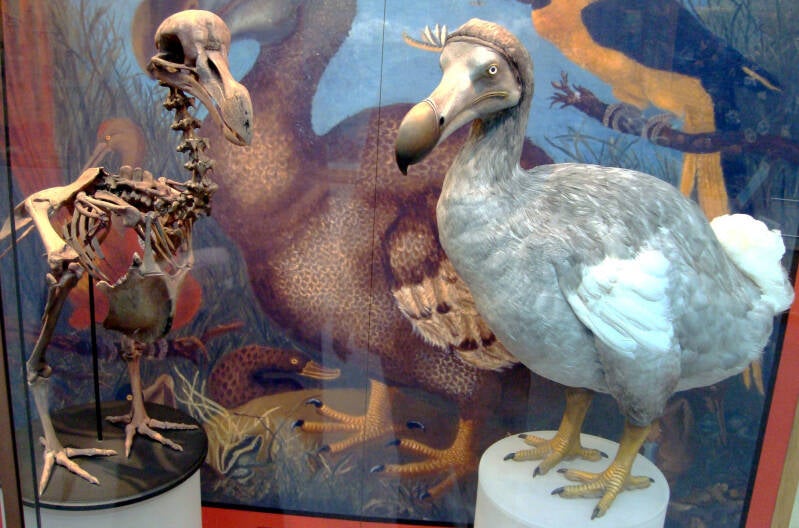
Dodo, Raphus cucullatus
The evolution of flightlessness has occurred repeatedly in birds—far more often than in most other vertebrate groups. This repeated pattern reflects both the high energetic cost of flight and the ecological conditions that can make flight unnecessary.
Early interpretations suggested that ratites descended from a single large, flightless ancestor on Gondwana, with continental drift separating populations. However, modern molecular studies have overturned this idea. DNA evidence indicates that ratites evolved from flying ancestors multiple times, with flightlessness arising independently in different lineages. For example, tinamous—small, ground-dwelling birds of Central and South America—are capable of flight and are now understood to be nested within the ratite lineage, implying that their common ancestor could fly.
This means that the large size and flightlessness of ratites evolved convergently, rather than being inherited from a single giant ancestor.
Why Lose Flight?
Flight is metabolically expensive. It requires lightweight skeletons, large pectoral muscles, and high-energy lifestyles. In environments where these costs outweigh the benefits, natural selection can favor flightlessness.
Several recurring ecological factors promote the loss of flight:
1. Absence of predators
On isolated islands or remote landmasses, birds often evolve without mammalian predators. In such settings, the need for rapid escape diminishes. Many island rails, for example, independently evolved flightlessness after colonizing predator-free islands.
2. Energy conservation
Maintaining flight muscles and the physiology required for sustained flight is costly. Ground-dwelling birds can redirect energy toward reproduction, growth, or survival. The kiwi, for instance, invests heavily in producing one of the largest eggs relative to body size among birds.
3. Niche specialization
Some birds became highly adapted to terrestrial running (e.g., ostriches, which can outrun many predators) or aquatic life (penguins, whose wings have transformed into flippers). In these cases, flightlessness is not a limitation but a trade-off that enhances performance in a different medium.
Flightless birds exhibit a suite of anatomical and behavioral changes. The most obvious is the reduction or absence of a keeled sternum. Wings are often reduced in size, while legs become more robust. In ratites, the leg musculature and tendons are highly developed for running, with some species capable of sustained high speeds.
In penguins, the transformation is even more dramatic. Their wings are rigid, paddle-like structures, and their bones are denser than those of flying birds, reducing buoyancy and aiding in diving. Behaviorally, many flightless birds are ground nesters, often producing fewer but larger eggs and investing heavily in parental care.
Flightlessness, while advantageous in certain contexts, comes with a major downside: vulnerability to introduced predators. Many flightless birds evolved in isolation and lack behavioral defenses against mammals such as rats, cats, and humans.
The tragic extinction of species like the dodo and numerous flightless rails illustrates this vulnerability. Today, conservation efforts for species like the kiwi and certain penguins focus heavily on predator control and habitat protection.
Flightless birds demonstrate that evolution is not a linear progression toward greater complexity or capability. Instead, it is a dynamic process shaped by environment and opportunity. The repeated, independent loss of flight across avian lineages highlights how adaptable birds are—and how quickly dramatic changes can occur when selective pressures shift.
In that sense, flightless birds are not exceptions to avian evolution but powerful examples of its flexibility.