Birds Attacking Windows
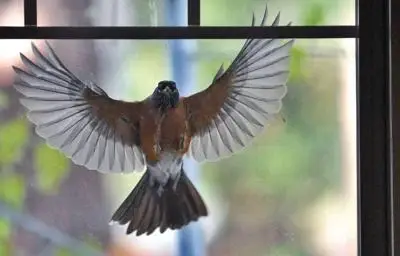
Birds striking or attacking windows is a familiar and often puzzling behavior, but it arises from a few well-understood biological causes. Broadly, these incidents fall into two categories: accidental collisions caused by reflection or transparency, and deliberate attacks driven by territorial aggression.
The most common situation is simple misperception. Glass reflects the surrounding environment—sky, trees, and vegetation—creating what appears to a bird as continuous habitat. To a flying bird, a window can look like open air or a safe passage through foliage. This is especially true during daylight when reflections are strongest. As a result, birds attempt to fly “through” the reflection and collide with the glass. These collisions are a major source of avian mortality worldwide, affecting both migratory and resident species.
Transparency can be just as dangerous. When a building has windows on opposite sides, or when indoor plants are visible through glass, birds may see a clear line of sight and attempt to fly straight through. In both cases, the bird is not behaving abnormally; it is responding to visual cues that, in nature, would indicate safe flight paths.
The second major cause—more dramatic to observe—is territorial aggression. During the breeding season, many species become highly defensive of their nesting areas. Males in particular will attack perceived rivals to protect access to mates and nesting sites. A window can act like a mirror, producing a reflection that looks like another bird intruding on the territory. Unable to recognize itself, the bird responds with repeated pecking, fluttering, and even full-body attacks against the glass.
This behavior is especially common in species with strong territorial instincts. Birds such as American Robins, Northern Cardinals, and various sparrows are frequent culprits. The attacks can continue for days or even weeks, typically peaking in spring when hormone levels and territorial drive are highest. From the bird’s perspective, the “intruder” never leaves, so the defense must be constant.
Interestingly, this behavior reveals something fundamental about avian cognition. Most birds do not possess self-recognition in the way humans do; they interpret reflections as other individuals. Only a few species, such as some corvids and parrots, have shown evidence of recognizing themselves in mirrors. For most birds, the reflection triggers instinctive responses tied to survival and reproduction.
Lighting conditions also play a role in both collisions and attacks. At night, especially during migration, artificial lights can disorient birds, drawing them toward buildings. Once near illuminated structures, they may collide with windows or become trapped in confusing reflections. During the day, the angle of sunlight can intensify reflections, increasing the likelihood of both accidental strikes and aggressive encounters.
Understanding these causes is important not only for curiosity but for conservation. Simple measures can greatly reduce window strikes. Applying decals, screens, or patterned films to glass breaks up reflections and signals to birds that the surface is not passable. Closing blinds or curtains can reduce transparency, while exterior shades or netting can further minimize risk.
Ultimately, birds are not “mistaken” in any careless sense—they are responding to visual environments that humans have unintentionally made deceptive. Whether driven by illusion or instinct, window strikes and attacks are a reminder that our built environment intersects with the natural world in ways that can profoundly affect wildlife.