BLOGS
15 July 2026 How Smoke from Canadian Wildfires Is Affecting Birds
Wildfires are a natural part of many Canadian ecosystems, and some bird species ultimately benefit from the openings, dead trees, and new vegetation that fires create. The smoke produced by today’s large and persistent fires, however, can affect birds hundreds or even thousands of miles from the flames. During the summer of 2026, hundreds of active Canadian fires sent smoke across much of Canada and the eastern United States, producing unhealthy concentrations of fine airborne particles over an enormous area.
Birds may be particularly vulnerable to smoke because their respiratory system is extraordinarily efficient. Air flows through the lungs and associated air sacs in a largely one-way pattern, allowing birds to extract the oxygen needed for flight. Unfortunately, this efficiency may also expose sensitive respiratory tissues to smoke particles and toxic chemicals. Wildfire smoke contains gases, volatile compounds, and microscopic particles known as PM2.5, which are small enough to penetrate deeply into the respiratory system. The precise physiological effects on wild birds remain poorly studied, but irritation, inflammation, oxidative stress, and reduced respiratory performance are reasonable concerns.
Recent studies indicate that smoke changes bird behavior as well as health. Researchers working in California found that heavier and more prolonged exposure to wildfire-related PM2.5 was associated with reduced capture rates and declining body mass in some birds. Lower capture rates may mean that birds were less active, moved away from smoky areas, or spent more time resting and sheltering. Chronic exposure was especially troubling because birds that lose mass may have fewer reserves for breeding, migration, molt, or surviving periods of bad weather.
Smoke can also interfere with communication. During the intense smoke event caused by Canadian fires in June 2023, researchers recorded reduced vocal activity among breeding grassland birds in New York. Songs are essential for claiming territories, attracting mates, maintaining pair bonds, and coordinating social behavior. A bird that sings less frequently may be less successful in defending a territory or reproducing. Grassland specialists and social species appeared particularly sensitive, raising concerns because many North American grassland birds are already undergoing serious population declines.
Migrating birds face another problem: whether to fly through smoke or detour around it. Tracking studies have shown that some migrants alter their routes and take longer to complete their journeys when confronted with extensive smoke. Such detours consume additional energy and may delay arrival at important stopover or wintering areas. Birds entering smoke may also have difficulty navigating because haze obscures visual landmarks, although the importance of this effect is not yet well established.
There are indirect consequences as well. Smoke can reduce sunlight, lower insect activity, damage vegetation, and alter the availability of fruits, seeds, and arthropod prey. Adults feeding nestlings may therefore have to forage longer while simultaneously coping with poor air quality.
Bird populations have evolved with occasional fire, but repeated continent-scale smoke events are different from brief, localized exposure. The greatest danger may be cumulative: several days or weeks of smoke occurring during nesting, migration, or molt, when birds’ energetic demands are already at their highest.
7 May 2026
The Global Big Day on Saturday May 9, 2026, is one of the largest citizen-science events in the world. For a single 24-hour period, birders across the globe try to observe and record as many bird species as possible and submit their sightings to eBird, the massive online bird database run by the .
The event usually occurs twice each year — May and October — timed to coincide with major migration periods in much of the world. During these days, birders from more than 200 countries contribute millions of observations. It has become both a celebration of birds and one of the most important large-scale wildlife data collection efforts ever created.
What makes Global Big Day remarkable is that anyone can participate. A professional ornithologist conducting surveys in the Amazon, a pelagic birder off California, a backyard feeder watcher in Ohio, and a schoolchild in India all contribute equally valuable data.
The mechanics are simple. Birders create “checklists” in eBird documenting species seen or heard, location, time, and effort information. Because every observation is geo-referenced and timestamped, the resulting dataset becomes scientifically powerful. Researchers use these data to study migration timing, range expansions, population trends, habitat use, and responses to climate change.
The scale is astonishing. Recent Global Big Days have produced over 7,500 species in a single day — roughly three-quarters of all bird species on Earth. Tens of millions of individual birds are effectively sampled through human observers distributed across continents and oceans.
For ornithologists, one fascinating aspect is how the event highlights biogeography and migration in real time. On a May Global Big Day, North American warblers flood the eastern U.S., shorebirds pour through Asian flyways, and austral migrants move through South America simultaneously. The global dataset becomes a snapshot of avian distribution on a planetary scale.
The event also changed birding culture. Historically, competitive “big days” were local affairs — teams trying to tally species within a county or state. Global Big Day transformed that concept into a collaborative enterprise. Although countries and individuals still compare totals, the emphasis is largely collective: building the largest biodiversity dataset possible in one day.
Another important feature is the democratization of ornithology. In many countries with limited formal research infrastructure, local birders now contribute critically important distribution records. Some species have been rediscovered, rare migrants documented, and range changes detected through eBird participation associated with these events.
There are also limitations scientists recognize. Observations are unevenly distributed geographically, with heavier coverage in North America and Europe. Detectability biases exist, and highly skilled birders contribute disproportionately. But the sheer volume of data, combined with statistical correction methods, has made eBird one of the most influential datasets in modern ecology.
From a broader perspective, Global Big Day represents a rare fusion of recreation, conservation, and science. Millions of bird observations gathered by volunteers now help shape conservation priorities worldwide. It is difficult to think of another wildlife group for which amateurs contribute so much scientifically valuable information on such a global scale.
Add comment
Comments
4 May 2026
Recently there was a 60 Minutes segment on the “pigeon mafia” of Belgium. Pigeon mafia is a colorful, semi-mythical term used to describe the intense, sometimes shadowy world surrounding Belgian pigeon racing—one of the country’s most storied traditions. Belgium has long been a global epicenter of the sport, producing elite racing pigeons prized for their endurance, navigation, and speed. At the highest levels, these birds can sell for astonishing sums—sometimes hundreds of thousands or even over a million euros—transforming a rural pastime into a high-stakes international business.
Within this lucrative environment, rumors of a “pigeon mafia” have emerged. The phrase doesn’t refer to a formal criminal syndicate so much as a network of breeders, traders, and competitors operating in a fiercely competitive—and occasionally secretive—market. Allegations have included pigeon thefts, clandestine doping practices to enhance performance, and covert deals involving prized bloodlines. In some cases, champion birds have been stolen from lofts under cover of night, suggesting organized targeting rather than opportunistic crime.
There is also a quieter, more nuanced side to the term. For some observers, “pigeon mafia” reflects the tight-knit, insular culture of elite fanciers, where knowledge, breeding secrets, and access to top birds are closely guarded. Reputation and trust are everything, and newcomers can find the community difficult to penetrate.
Yet, for all the intrigue, Belgian pigeon racing remains a deeply rooted cultural institution, with most participants driven by passion rather than profit. The “mafia” label persists largely because high stakes, tradition, and human ambition inevitably create stories that blur the line between folklore and reality.
Add comment
Comments
20 April 2026
New York state officials are urging residents and businesses to turn off nonessential lighting at night during peak migration seasons to help protect birds traveling through the region.
The New York State Department of Environmental Conservation and the Office of General Services announced participation in the national “Lights Out” initiative, which aims to reduce bird deaths caused by artificial lighting. State-managed buildings will switch off nonessential outdoor lights from 11 p.m. to dawn during the spring migration period from April 15 through May 31, and again during the fall migration from Aug. 15 through Nov. 15.
“Turning off lights is a simple but effective way to support the long-term well-being of migratory birds,” DEC Commissioner Amanda Lefton said. “Birds play a critical role in maintaining healthy ecosystems, and small actions can make a meaningful difference.”
New York lies along major migratory flyways, serving as a key passage for hundreds of bird species each year. Many birds navigate at night using natural light from the moon and stars, but artificial lighting can disorient them — a phenomenon known as fatal light attraction — leading to deadly collisions with buildings.
Office of General Services Commissioner Jeanette Moy said the state oversees more than 20 million square feet of office space and is committed to reducing light pollution to support safe migration.
Conservation groups say the impact is significant. Research cited by the NYC Bird Alliance estimates that artificial light contributes to hundreds of thousands of bird deaths annually in New York City alone.
“Turning off lights saves birds, saves money and improves quality of life,” said Dustin Partridge, the group’s director of conservation and science.
Officials are encouraging residents to participate by reducing overnight lighting, closing blinds and taking steps to make windows more visible to birds. Additional recommendations include planting native species and removing invasive plants to improve habitat.
Advocates say the initiative not only benefits wildlife but also reduces energy use and costs, making it a practical step for both environmental and economic reasons.
Add comment
Comments
14 April 2026
Ornithologists are increasingly advising people to take down backyard bird feeders—at least temporarily—not because feeding birds is inherently harmful, but because under certain conditions it can create serious risks for bird populations.
A central concern is disease transmission. Feeders concentrate birds in unnaturally dense numbers, turning them into hubs for pathogens such as salmonellosis and avian conjunctivitis. Seed debris and fecal matter accumulate on feeder surfaces, allowing bacteria and viruses to spread rapidly among individuals that would otherwise be more dispersed across the landscape. During outbreaks, species like finches and sparrows can experience noticeable local declines. Temporarily removing feeders helps break these transmission pathways.
Another issue is the attraction of predators. Feeders effectively create predictable gathering points, not just for birds but for animals that prey on them. Domestic cats are a major concern, as they quickly learn to patrol feeder areas, where birds are distracted and less vigilant. Raptors such as Cooper’s hawks may also key in on feeders, taking advantage of the concentration of prey. While predation is a natural ecological process, feeders can artificially elevate predation rates by making birds easier targets in confined spaces.
There are also subtler ecological effects. Feeders can alter natural foraging behavior, reduce dietary diversity, and encourage dominance by aggressive or invasive species such as the house sparrow. In some cases, unusual mortality events involving species like the American goldfinch have prompted precautionary feeder removals while causes are investigated.
Importantly, this guidance is typically temporary and situational. When disease risks are low, properly maintained feeders—cleaned regularly and spaced to reduce crowding—can still be beneficial. The goal is not to discourage feeding altogether, but to ensure it does not inadvertently harm the very birds people hope to support.
Add comment
Comments
10 April 2026
Lots of times we read about the news in far-flung places and I don't know about you but I always wonder what the avifauna is in this exotic locales. The Strait of Hormuz , often in the news lately, features a diverse mix of seabirds, migratory shorebirds, and desert species inhabiting the surrounding rocky coastlines and islands. Key species include the Western Reef-Heron, Greater Sand-Plover, Eurasian Curlew, Lesser Black-backed Gull, and the rare Persian Shearwater (Puffinus persicus), which inhabits the Gulf waters.
Common Bird Species:
Seabirds & Gulls: Lesser Black-backed Gull, Great Cormorant, Heuglin’s Gull, and Black-headed Gulls are common, particularly in winter.
Shorebirds & Waders: Western Reef-Heron, Greater Sand-Plover, Eurasian Curlew, Common Greenshank, Black-winged Stilt, and Common Redshank.
Coastal & Inland Species: Red-wattled Lapwing, Great White Pelican, and Gray Heron.
Desert/Land Birds: Desert Lark, Hume's Wheatear, White-eared Bulbul, Blue Rock-Thrush, and Laughing Dove are frequently spotted on coastal islands like Hormuz.
Raptors: Egyptian Vulture and Short-toed Snake-Eagle have been observed in the region.
Hormuz Island: A significant area for observing species like the Desert Lark and various waders.
Wintering Grounds: The area is a vital wintering spot for gulls and shorebirds.
E-Bird List of the Birds of Hormuz
Add comment
Comments
9 April 2026
During episodes of bombing or aerial conflict over a large city like Tehran, the sudden visibility of pigeons in the sky is both striking and, from a biological standpoint, entirely predictable. Urban pigeons—descendants of the rock dove (Columba livia)—are deeply adapted to human-built environments, and their behavior under disturbance reveals much about their ecology.
Explosions, shockwaves, and sirens act as powerful disturbance stimuli. Pigeons possess highly sensitive auditory and visual systems, and even minor disruptions can trigger what is known as a “flush response”—a rapid, coordinated takeoff of an entire flock. In wartime conditions, repeated blasts create a near-continuous cycle of flushing and resettling, so observers may see unusually large numbers of birds airborne at once.
Tehran, like many Middle Eastern cities, supports dense pigeon populations. Architectural features—ledges, minarets, and older masonry—mimic the cliff faces these birds evolved to inhabit. In times of crisis, these structures become both refuge and launch point, allowing flocks to take to the air quickly and circle at altitude until conditions feel safe again.
Interestingly, flocking itself is a survival strategy heightened during such disturbances. Tight aerial formations reduce individual predation risk and improve navigation when visibility is compromised by smoke or dust. The swirling, almost synchronized movements people observe are not random panic but highly evolved collective behavior.
There is also a historical irony here. Pigeons have long been associated with warfare—not as victims, but as participants. For centuries, homing pigeons were used to carry messages across battlefields because they were fast, reliable, and difficult to intercept . In a modern city under bombardment, their presence evokes that history, even though today they are simply bystanders.
What may appear as chaos in the sky is, in fact, a testament to resilience. Urban pigeons are among the most adaptable birds on Earth. Even in the midst of human conflict, they continue to respond in ways shaped by millions of years of evolution—taking flight, regrouping, and returning, again and again, to the same battered cityscape.
Add comment
Comments
6 April 2026
April is a peak birdwatching month, driven by northward spring migration in the northern hemisphere and the start of nesting season. Migrants like warblers, vireos, and tanagers return, while resident birds establish territories. Key species include hummingbirds, swallows, and various songbirds. Some will just be passing through (transients) and the residents will be building nests and the songbirds will be singing.
Add comment
Comments
12 June 2026
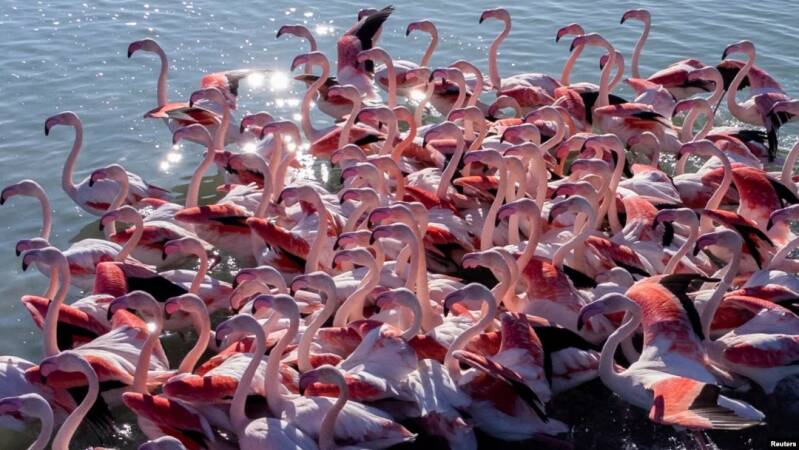
Jared Kushner and Ivanka Trump (President Trump's son-in-law and daughter) partnered with an investment firm to develop a $1.6 billion luxury eco-resort in Albania. The site of the proposed development—Sazan Island and the nearby Vjosa-Narta lagoon—is a protected wetland and the primary nesting ground for thousands of flamingos.The start of construction using heavy machinery inside the protected coastal wetlands sparked mass protests in the Albanian capital of Tirana. Activists adopted the pink flamingo as their primary mascot and symbol of resistance to oppose the Trump-linked development, leading the demonstrations to be dubbed the "Flamingo Revolution".
Add comment
Comments