Avian Digestive System
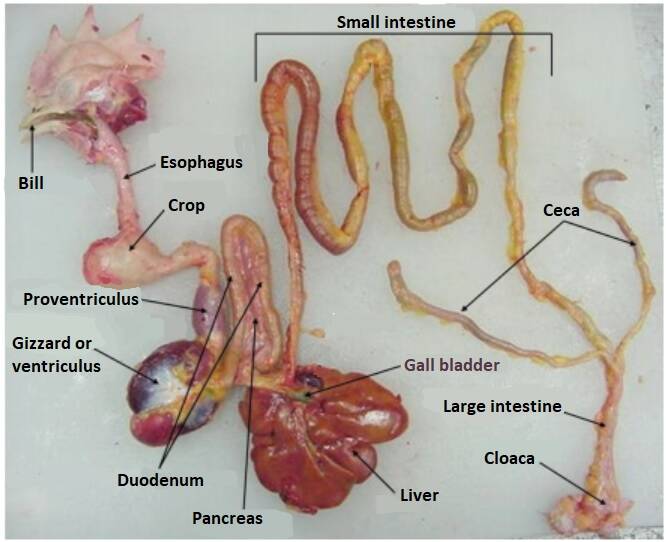
The avian digestive system is a beautifully specialized assembly of organs that reflects one overriding constraint: birds must process food efficiently while minimizing body weight for flight. The result is a system that is both highly effective and, in several respects, quite unlike that of mammals. It integrates mechanical processing, chemical digestion, rapid nutrient absorption, and—crucially—flexibility to accommodate diverse diets ranging from nectar to carrion.
General Layout of the Avian Digestive Tract
The avian digestive tract follows a linear path: beak → oral cavity → esophagus → crop (in many species) → proventriculus → gizzard → small intestine → large intestine → cloaca. Along this path are accessory organs—the liver, pancreas, and gallbladder (in most species)—that contribute enzymes and bile.
Unlike mammals, birds lack teeth, so food is not chewed in the mouth. Instead, digestion relies heavily on downstream mechanical and chemical processes.
Beak and Oral Cavity
The beak is the first stage of digestion and is highly adapted to diet. In seed-eating finches, it acts as a crushing tool; in raptors, as a tearing instrument; in nectar-feeders, as a delicate probe. Salivary glands are generally modest compared to mammals, but saliva may contain mucus and sometimes enzymes (e.g., amylase in a few species).
Because birds do not chew, the oral cavity primarily functions in food capture and initial handling, not breakdown. This places greater importance on the rest of the digestive system.
Esophagus and Crop
The esophagus is typically expandable, allowing birds to swallow relatively large food items. Many species possess a crop, a diverticulum of the esophagus used for temporary storage.
The crop serves several purposes:
Storage: Birds can gather food quickly and digest it later in a safer location.
Softening: Seeds and other tough items may begin to soften here.
Specialized functions: In pigeons and doves, the crop produces “crop milk,” a nutrient-rich secretion fed to nestlings.
Not all birds have a well-developed crop. For example, many carnivorous birds have little need for prolonged storage.
Proventriculus: The Glandular Stomach
The proventriculus is the first of the two-part avian stomach and corresponds to the glandular stomach in mammals. Here, food is exposed to:
Hydrochloric acid
Pepsin and other digestive enzymes
This stage initiates chemical digestion, particularly of proteins. In some birds (e.g., raptors), the proventriculus is highly active in breaking down flesh and dissolving soft tissues before mechanical processing.
Gizzard: The Muscular Stomach
The gizzard (ventriculus) is one of the most distinctive features of avian digestion. It is a thick-walled, muscular organ responsible for mechanical breakdown of food.
Powerful muscles that contract to grind food
A tough internal lining (the koilin layer) that protects the organ
Often, the presence of gastroliths (small stones) swallowed by the bird to aid grinding
In granivorous birds, the gizzard is especially well developed, effectively substituting for teeth. In carnivorous species, it may be less muscular but still functions to compact indigestible materials such as bones, fur, or feathers into pellets for regurgitation.
Small Intestine: Digestion and Absorption
From the gizzard, food enters the small intestine, which is the primary site of enzymatic digestion and nutrient absorption.
The small intestine is divided into:
Duodenum: Receives bile from the liver and digestive enzymes from the pancreas
Jejunum and ileum: Sites of most nutrient absorption
The pancreas secretes enzymes that break down proteins, carbohydrates, and lipids, while the liver produces bile to emulsify fats.
Birds generally have a relatively short digestive tract, reflecting the need for lightweight efficiency. However, intestinal length and complexity vary with diet—herbivorous birds tend to have longer intestines to accommodate the digestion of fibrous plant material.
Cecae and Large Intestine
Many birds possess paired cecae at the junction of the small and large intestines. Their size and function vary widely:
In herbivorous and omnivorous birds (e.g., grouse), the cecae may be well developed and house microbial communities that ferment plant material.
In carnivorous birds, the cecae are often reduced.
The large intestine is short and primarily involved in water reabsorption. Birds do not typically store feces for long periods, again reflecting weight constraints.
Cloaca: Final Processing and Excretion
The digestive, urinary, and reproductive systems converge at the cloaca, a multifunctional chamber divided into regions (coprodeum, urodeum, proctodeum).
Birds excrete:
Fecal material from digestion
Uric acid (a nitrogenous waste product)
Uric acid is excreted as a semi-solid paste rather than liquid urine, conserving water and reducing weight—an important adaptation for flight.
Functional Adaptations to Diet
One of the most fascinating aspects of the avian digestive system is its plasticity. Digestive organs can change in size and function depending on diet and season.
Migratory birds shrinking digestive organs during long flights to reduce weight, then rebuilding them upon arrival.
Seed-eaters enlarging gizzards when consuming harder foods.
Frugivores maintaining rapid gut transit times to process large volumes of fruit.
This flexibility is supported by rapid tissue turnover and metabolic regulation.
Efficiency and Speed
Birds often process food remarkably quickly. Passage times can be as short as 30 minutes in some species, particularly those consuming easily digestible foods like nectar or fruit.
This rapid throughput allows birds to:
Maintain high metabolic rates
Process large quantities of food
Minimize the burden of carrying undigested material
However, it also means that digestive efficiency must be finely tuned—there is little margin for error.
Specialized Cases
Several bird groups exhibit striking digestive specializations:
Raptors form and regurgitate pellets containing indigestible material.
Hoatzin (Opisthocomus hoazin) relies on foregut fermentation, with an enlarged crop functioning somewhat like a ruminant stomach.
Nectar-feeders (e.g., hummingbirds) have simplified systems optimized for rapid sugar absorption.
Seabirds often possess salt glands (not strictly digestive, but functionally related) to handle excess salt intake.
Concluding Perspective
The avian digestive system is a study in evolutionary compromise and innovation. It must reconcile the conflicting demands of high metabolic intensity, dietary diversity, and the physical constraints of flight. By shifting mechanical processing to the gizzard, reducing unnecessary weight, and maintaining remarkable physiological flexibility, birds have evolved a system that is both efficient and adaptable.
From the grinding stones of a sparrow’s gizzard to the fermentation chamber of a hoatzin’s crop, the diversity of digestive strategies mirrors the extraordinary ecological breadth of birds themselves.